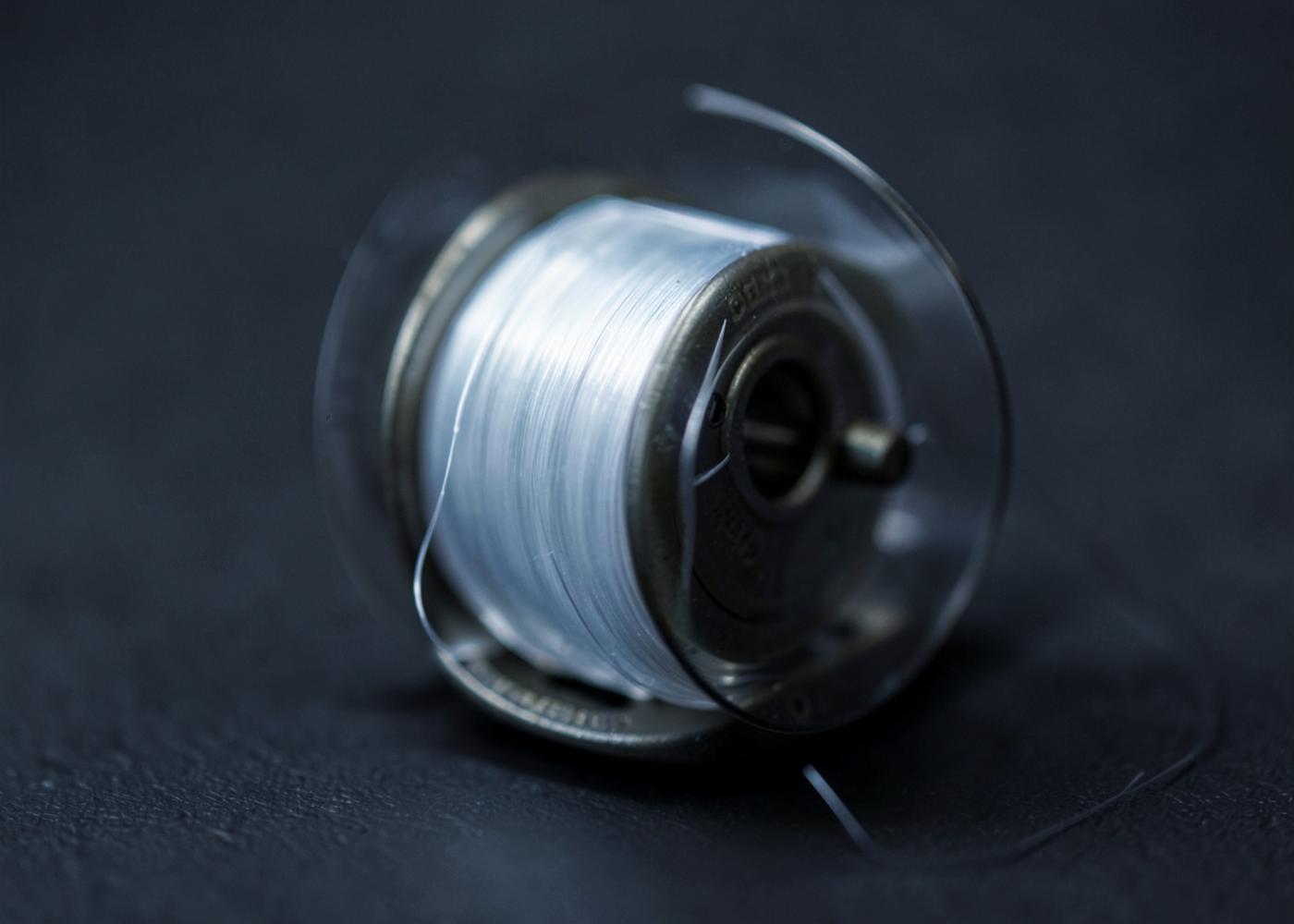
Ester
Polyester monofilament, usually called ester, is the line most associated with dedicated Ajing. Its defining property is very low stretch for a monofilament, combined with a density that sinks and a fine diameter for its rated strength.
The consequence is directness. A sub-gram jighead on ester communicates its own weight, and the moment that weight changes is obvious. The cost is brittleness: ester is notably intolerant of shock loading, sharp knots and abrasion, and it degrades with handling.
PE
PE is braided polyethylene: effectively no stretch, very high strength for diameter, and a floating, supple character. In light game it is used where distance, wind resistance and durability matter more than pure fall sensitivity.
Because it floats and is wind-affected, very fine PE can bow badly in a crosswind, and that bow is precisely what hides the small bites you were hoping to feel. PE also has no shock absorption of its own, so a leader is not optional.
Fluorocarbon
Fluorocarbon sinks, is relatively abrasion-resistant, has a refractive index close to water and stretches more than ester but less than nylon. As a mainline it is the most forgiving of the three; as a leader it is the standard choice for all of them.
The stretch that makes it forgiving also softens information. On a long cast, a light head on fluorocarbon tells you less about its own fall than the same head on ester.
Stretch, sensitivity and diameter
These three properties are the real subject. Stretch determines how much of a small event survives the journey to your hand. Diameter determines how much the water and the wind interfere with that journey. Sensitivity is simply what is left after both.
This is why a thinner line often feels more sensitive than a technically lower-stretch but thicker one: less drag means less bow, and less bow means a straighter path for information.
Casting and water behaviour
PE casts the lightest rigs furthest, but is the most affected by wind above the water. Ester sits between the two and cuts through a light breeze better than PE of similar strength. Fluorocarbon sinks fastest, which helps contact in current but drags a very light lure down more quickly than intended.
In a crosswind the practical ranking often inverts: a sinking line under the surface is less disturbed than a floating line across it.
Abrasion, leaders and knots
All three are normally fished with a fluorocarbon leader, for different reasons. PE needs one because it has no abrasion resistance and no stretch. Ester needs one because it is fragile at the terminal end. Fluorocarbon mainline arguably needs one least, but a short section still protects the working knot.
Knots matter more here than in almost any other style. Ester in particular dislikes tight, heat-generating cinches — moisten generously, tighten slowly, and re-tie more often than feels necessary. With PE, a slim, well-seated leader knot that passes cleanly through small guides is worth more than raw knot strength.
Comparison
| Ester | PE | Fluorocarbon | |
|---|---|---|---|
| Stretch | Low | Essentially none | Moderate |
| Fall sensitivity | Excellent | Good, wind-dependent | Moderate |
| Diameter for strength | Fine | Finest | Thickest |
| Water behaviour | Sinks slowly | Floats | Sinks |
| Wind tolerance | Good | Poor when very fine | Good |
| Abrasion resistance | Low | Low | High |
| Shock tolerance | Low | Low | Moderate |
| Leader | Essential | Essential | Recommended |
| Best suited to | Fine presentations, close range | Distance, deeper water | Structure, mixed species |
Practical scenarios
- Calm harbour, sub-gram heads, soft bites on the fall: ester with a short fluorocarbon leader.
- Open breakwater, wind, longer casts, heavier heads: fine PE with a fluorocarbon leader.
- Rocky ground, wrasse and mixed light game, snag risk: fluorocarbon mainline.
- Cold hands, night fishing, frequent re-tying: fluorocarbon or PE, since ester punishes rushed knots.
- First light-game setup, one line for everything: fluorocarbon is the most forgiving starting point.
The mistake of choosing line by strength alone
The most common error I see discussed is treating the strength rating as the specification that matters. In light game it is usually the least relevant number on the spool. Fish of this size are not the load that breaks light line; bad knots, shock loading and abrasion are.
Choosing a heavier rating to feel safer has a real cost: a thicker line bows more in current and wind, sinks a light head less predictably, and quietly removes the sensitivity you bought the rod for. The more useful question is what diameter still lets the lure behave correctly — then whether that diameter is strong enough, and whether your drag and leader can cover the difference.
Inn River is independent. It does not sell tackle, represent manufacturers or publish paid placements as editorial recommendations.