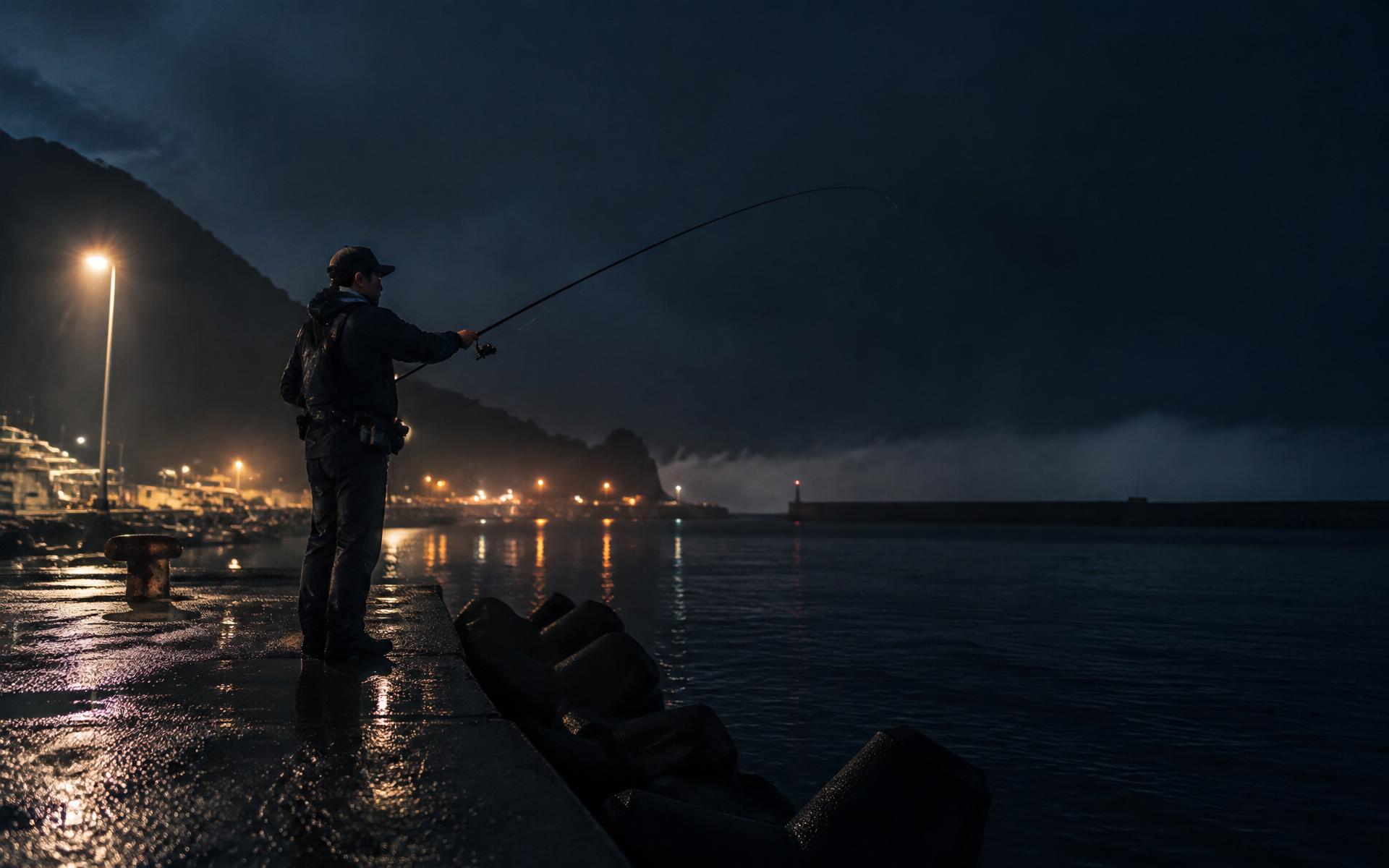
In Japanese, aji (鯵) means horse mackerel, and Ajing is simply fishing for them with artificial lures. It began in Japan, but the same methods and gear translate directly to the Atlantic horse mackerel — carapau, scad — found along the entire European coast. What defines Ajing, though, is not the fish but the method: a highly technical, finesse-driven approach to presenting a very small lure.
More than a species
The aim is to present a tiny lure naturally, control its position in the water column and detect the smallest signals: a fish touching the lure, the lure stopping on the fall, a change in line tension, bottom contact, current moving the lure, or a fish simply loading the rod. The objective is not the biggest movement — it is the right movement, and reading what happens next.
Ajing vs LRF
Light Rock Fishing (LRF) is a broad, versatile multi-species approach on light tackle. Ajing is its specialised core: tackle engineered to detect a microscopic bite in mid-water and hook a thin, soft mouth without tearing it. All Ajing is LRF — but not all LRF is Ajing. Many anglers use Ajing gear for everyday LRF because the sensitivity is unmatched.
Why such light tackle
The problem is controlling the presentation, not just landing the fish. A light jighead sinks slowly and is moved by current, so rod, reel, line, leader and jighead work as a single system — and the lighter it gets, the more every component matters. Typical gear runs to short, crisp rods (solid or tubular tip), a small 1000/C2000 reel, ester line or thin PE with a fluorocarbon leader, and tungsten or lead jigheads from sub-1g to around 2g behind slim 1.5–2.5 inch soft plastics.
Count down and fall
The core technique is simple to learn and hard to master: cast to a lit area, count the lure down to map the depth, give two or three sharp twitches, then let it fall on a tight line. Most bites come on that fall — any tick, pause or sideways movement is the signal to strike.
Read further on Ajing
Further reading
Everything above is explained in greater depth, with examples and technique detail, in these external references:
These are external references, not Inn River content. Inn River is an independent publication and holds no commercial relationship with any retailer or brand mentioned here.