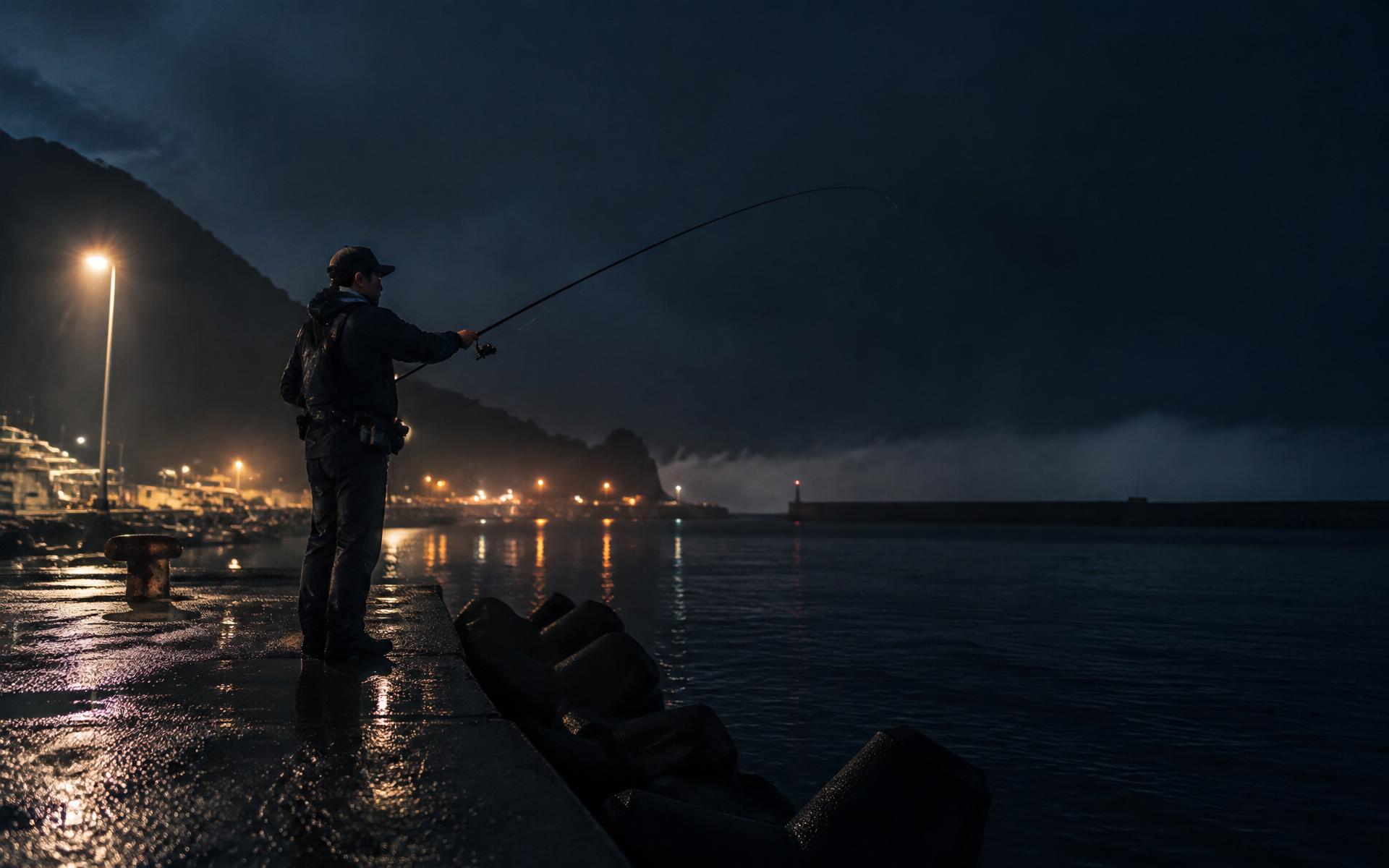
Don't fish the light. Fish the transition
When I approach a lit harbour, I try not to start by asking where the fish are. I start by asking what the water is doing. Light is simply the most visible thing in that scene, and the most tempting to treat as the whole explanation.
Artificial light concentrates plankton, plankton concentrates small baitfish, and predators arrange themselves around that concentration. But they rarely sit inside the brightest patch. The productive water is normally the boundary: the line where lit water becomes dark water, where a fish can hold in cover and look outward into a lit stage.
Practically, that means casting along the edge rather than into the centre of the glare, and retrieving so the lure crosses the line rather than running parallel inside it. A lure that appears out of the dark, drifts through the lit band and disappears again is doing something far more interesting than a lure worked back and forth in full illumination.
Why the darkest water can be the interesting water
The dark side of the transition is the part most anglers ignore, partly because nothing can be seen there. That is exactly its value. A fish in shadow has a visual advantage and no reason to leave it until something worth intercepting passes by.
Fishing blind water requires a different kind of attention. You have no visual feedback at all, so the count, the line angle and the feel of the jighead become the only instruments you have. This is where ultralight tackle stops being an affectation and starts being the point.
Count the lure down
Counting is the simplest way to turn an unknown volume of water into a map. Cast, let the jighead sink on a controlled line and count. If a fish responds at a count of eight, you now have a depth to repeat rather than a lucky cast to remember.
Two habits make the count useful. Keep the line reasonably tight so the lure falls on a predictable arc, and change one variable at a time — the count, or the head weight, but not both at once. A count is only information if everything else stayed the same.
- Count down in fixed increments and note where contact happens.
- Repeat the productive count before exploring deeper.
- When bites stop, extend the count before changing lure.
- Treat a sudden loss of tension as a bite until proven otherwise.
Current changes everything
Current is the variable that quietly rewrites everything else. It changes how fast a light head sinks, where the lure actually is compared with where you think it is, and how much of the fall you can feel through the line.
In moving water the same jighead behaves like a lighter one, the line bows, and small bites are absorbed by that bow before they reach the rod tip. The usual answers are to cast more directly up or down the flow, to shorten the drift, or to add a small amount of weight — not because heavier is better, but because contact is the thing being protected.
What I look for
My own priority in a lit harbour, in order: the transition line, then depth change, then current, then structure. A pontoon corner where a shadow line crosses a depth change and a steady tidal flow is more promising to me than a long, evenly lit wall with nothing happening under it.
I also pay attention to what the surface tells me. Fine dimples and nervous water usually mean small bait near the top and a case for a very slow, high presentation. A flat, quiet surface over deeper water usually means the fish are lower, and the count matters more than the retrieve.
A simple first approach
If the harbour is unfamiliar, the least wasteful opening is deliberately plain. Start light, work the edge, map the depth, and only then start changing things.
- Position so you can cast along the light edge rather than into it.
- Start with the lightest head that still lets you feel the fall.
- Count down in stages until you find contact or bites.
- Fish two or three small twitches, then a controlled fall.
- Change one thing at a time: count, weight, then profile.
Conclusion
Ajing in a lit harbour rewards observation more than it rewards tackle. The light is only a clue; the transition, the depth and the flow are the actual subject. Once the water is read that way, the choices about jighead weight, line and lure stop feeling arbitrary and start following from something you have actually noticed.
Inn River is independent. It does not sell tackle, represent manufacturers or publish paid placements as editorial recommendations.